This was brought up with me at the “puppy party” last Sunday. One of my guests was telling me how he was interested in “testing” one of his dogs after he brought the dog home (I don’t recall what age he was “testing” this puppy/dog?) I responded that yes, we do do “early neurological stimulation”. Does it make a big difference long term? Is it really worth doing it? Hmm…
My feeling has always been that it can’t hurt the puppies. And if it helps puppies have a better tolerance to stress and a greater resistance to disease later in life, why not do the early stimulation! And because “I breed for myself”, I’m down for anything that will make MY puppy a better dog!
The stimulation I am talking about is from the “bio sensor” program first developed by the military for their canine program. It consists of five types of early tactile stimulation done to puppies to stimulate their neurological system. The stimulations is done once per day from day three until pups are sixteen days old. It is just something we do for every litter.
There are five exercises or stimulations:
Tactile stimulation (between toes)
Head held erect
Head pointed down
Supine position
Thermal stimulation
The benefits of Stimulation:
Improved cardio vascular performance (heart rate)
Stronger heat beats
Stronger adrenal glands
More tolerance to stress
Greater resistance to disease
These early stimulations are then followed up with various socializing activities (many I’ve already mentioned in the puppy packets). The “window of opportunity” for socializing puppy to those various things that he/she will likely encounter during his/her lifetime is relatively narrow but well worth the effort to get puppy exposed to as many of those things mentioned previously as possible.
And as far as the benefits of that early neurological stimulation… I prefer to err on the side of providing it than neglecting to do it. Here’s hoping that all of “my” puppies grow up to be “super dogs”!
(Link below if anyone cares to read more about this… )
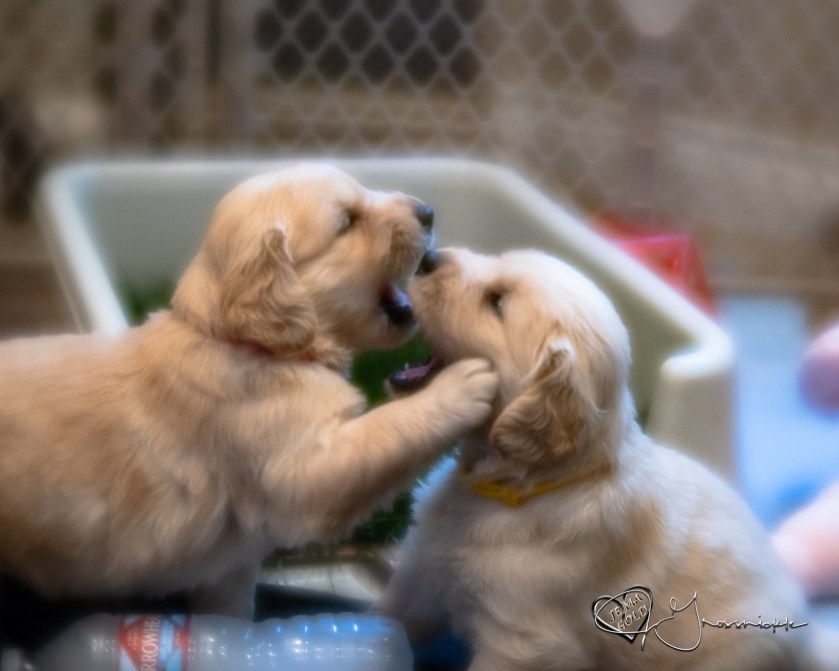
I’m using one of my favorites lenses for the below photos. This lens gives a velvety soft look to the shot which may not be the best for moving puppies (the lens requires manually focusing!) Still, it was fun to “play around” taking puppy photos!
Potty box or play box? Pups are playing harder with each other nowAnd they are experimenting with their mouths/teeth!
Treating Deja for mastitis… First time for everything!
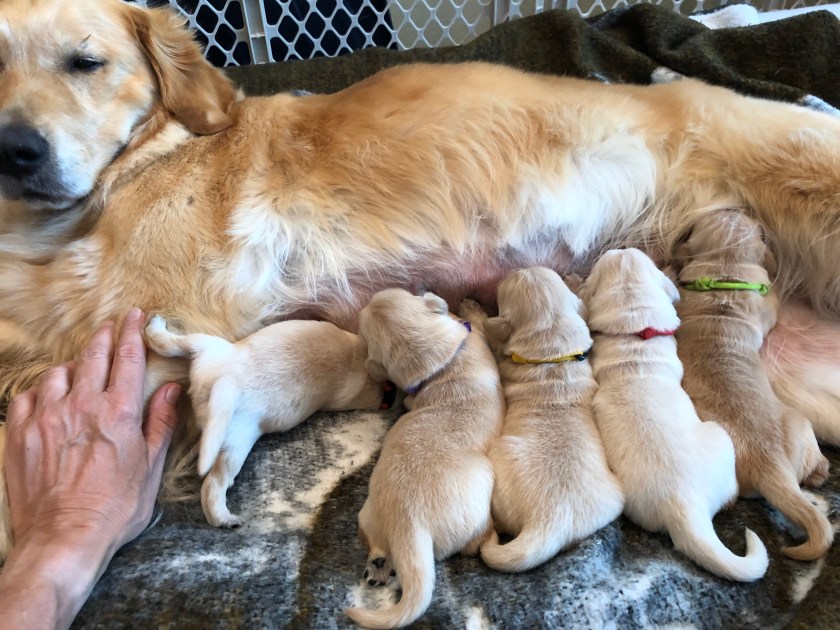
What a day (and night)! It started off great celebrating the puppies First Week Birthday. Posted photos, answered emails, spent time with the other critters… And then I’m watching Deja who is in with her puppies but not letting them nurse? I sit with Deja and examine her belly… Is her C-section incision bothering her? Instead, I noticed a lump in one of her nipples. A definite hard nodule that concerned me. In addition, she had a hardened area on her belly?
This is when less experienced breeders run into problems. They may not recognize something is wrong? Now I’ve never had a girl have problems with mastitis nor did Deja have this problem with her first litter but… Something was wrong!
I did a quick google search; funny how that is now easier than looking up a chapter in any book. And I put myself “out there” asking a question in a “group”. LOTS of immediate responses! I knew about cabbage wraps but wasn’t sure how they were applied; question asked and answered! Texted hubby to pick up cabbage on his way home from work.
Cabbage is frozen then applied along her mammary chain as a cold compress
Meanwhile, I had already started the standard things one can do… warm compresses to the hardened area and massage. I put one of the puppies on the effected nipple to drain it. Of course, this made it difficult to manually express it myself to really examine what the ducts were producing! And then I get a response from a gal who commented on one of the photos that she would love to “puppy sit”. Her intentions were to “help” and to spend time with the puppies but I was thinking, she wouldn’t notice nor know what to do for this problem. That would make me more nervous than anything!
And then “worse case scenario” photos posted to “help me”? OMGosh… Now I am beginning to panic! What if this is that scenario?! Privately, I’m being messaged what helped someone else in this situation. Sound advice!
Hubby gets home with the cabbage and we do the sequence of cold compresses, warm compresses, massage, and puppies nursing. And… hubby calls the vet to get Deja in NOW!
We load up Deja and pups to go to the vet. Deja is such a good girl; she complies with what we ask her to do. The puppies are now almost too big for the warming box I use to bring home puppies; their little heads are pushing up trying to get to “mom” next to them in her crate. Their eyes and ears are not yet open but they can smell her. And they are crying for her too! Deja sees her pups and knows that they are safe next to her so is not worried.
Deja’s temp was normal until I started the massage. I am sure I caused some inflammation that pushed some of the bacteria into her blood stream that now caused the rise in temperature. Of course we’ve been taking Deja’s temp regularly since puppies arrived.
Deja is examined by the vet tech and vet upon our arrival. Antibiotics prescribed along with what I was currently doing. NOT DOING the compresses/massage would have made this situation worse. And I’m reassured this is NOT the “worse case scenario”! Although we brought with us a sample of the gunk from one of the ducts, a new sample is obtained to send in for a culture. We won’t have the results back for a few weeks and I’m thinking… Hopefully by the time we get the results back, this will be a distant bad memory?
In addition to the cold cabbage/warm compresses/massage/nursing cycle and the antibiotics, Deja is now on a probiotic that will also pass to the puppies through her milk. Although Deja’s antibiotic is safe for the puppies, it could give them diarrhea killing off the “good” flora in their guts. I had already ordered probiotics for the pups in a gel form to wipe on their tongues. At this age, they may have difficulty swallowing so care will be needed to not let them aspirate the gel probiotic. But the last thing I want to happen is for the puppies to start having diarrhea!
I also ordered Lecithin (from sunflowers) that is supposed to help with mastitis and the ducts. My vet had not heard of this but hearing this from the collective wisdom of my group, it will be started. While at the vet, I asked for a light-laser treatment. This promotes healing and is cumulative. I will likely take Deja in to the vet again soon for another laser treatment. I want that hardened mass to soften and disappear as soon as possible!
Tag-teaming with hubby, Deja’s “treatements” were done every two hours throughout the night by hubby. The hardened area is already beginning to soften. Deja is feeling better herself and ate this morning (which also included her probiotic). And being the good mommy that she is, she is back to nursing her babies. Now ALL of the puppies have a good nursing reflex but we put one of the bigger boys on the effected nipple to help drain it. We need to clear that duct(s) and get that nipple working again! And her temp is back down to “normal”.
I’ll continue the compresses/massage today and was thinking… This is why puppies are in THE MOST accessible area in our house! Puppies are not raised in a basement, garage, or barn/out building! I don’t know how people do that and are able to monitor/watch mom and pups? Had we waited or not noticed the problem until it was more severe, the outcome could have been much worse. I still can’t get the “worse case scenario” photos out of my head! Scary, scary thing to happen! Fortunately, Deja is already improved and hopefully will continue to improve. And this is now just another experience I’ve had “raising puppies”. It is definitely a labor of love!
Jennifer
P.S. Puppies are now getting up on all 4’s! Since their eyes are not open, they can’t really see where they are going so… they look like little drunk potatoes! LOL!
Last weekend, we took ALL the dogs to a health clinic sponsored by a local dog club. This health clinic is put on every year and coordinated by a local dog person, Carolyn. Carolyn does a WONDERFUL job organizing it! She even forgives me for changing my last-minute registration which I am sure messes up her timing/organization of all the dogs that attend this clinic. (So sorry for having done that, Carolyn!)
Years ago, we piled all the dogs in our “dog van” that we used to go to dog shows when we didn’t take the RV. Knowing we weren’t going to use it much any longer, we sold the van a few years ago. This makes transporting the dogs to this health clinic a bit tricky!
Fortunately, my son agreed to help us “hold dogs” until it was their turn to be seen by the various specialists. In his car, he took one dog in a crate. I drove taking two crated dogs, and dear hubby drove also with crated dogs.
My changes? While Deja and Doodle were recently at my repro vet having blood drawn for progesterone levels, I had them add-on a heartworm test. Now that I know both of them are negative for heartworm, I can start the heartworm preventative I give throughout the summer. Deja and Doodle still needed their eyes tested though.
And then my very old, very sweet Cavalier had a problem with her anal glands. While not planned to do at this time, we went ahead and had her “senior wellness” done for the year. This included a heartworm test so now she no longer needed to go to the health clinic for this test. It also included a dental where my poor baby had yet another tooth pulled. While under anesthesia for her dental cleaning, we had the vet remove a few lumps and bumps. Cali will be back at the vet this Friday having those stitches removed.
Once we all arrived at the clinic held at a local vet office, all the dogs have their eyes dilated for their appointment with the veterinarian ophthalmologist. As they say, “the eyes are the windows to the soul”. Believe it or not, these eye exams can pick up other problems the dog may have. Last year at this health clinic, my beautiful grand-champion boy, Tazo, had retinal bleeds. He passed his eye certification but we were advised to have him seen by our vet sooner than later. At that vet appointment, Tazo was diagnosed to be in renal failure! We “lost” him four months later when his renal failure became apparent; they don’t do dialysis on dogs which is what he would have needed. It was so hard to believe he had such a serious health problem that was diagnosed from an eye exam!
As you can imagine, all the dogs stayed OUT of the sunlight for the rest of the day after having their eyes dilated. The eye forms filled out by the eye doc are then sent to OFA (Orthopedic Foundation for Animals) that adds my dogs to their registry of dogs with eye clearances. This is done every year with Golden Retrievers.
Golden Retrievers also need a heart clearance done by a veterinarian cardiologist. They need to be over a year of age for this health clearance. My sweet “puppy”, Pixel, turned one year last August! Time for her to have her heart checked! That form also filled out by the specialist is also sent off to OFA. Pixel still needs her hips and elbows x-rays to be done but they need to be over two for these permanent clearances. She will have them done this August.
And then there is “Beanie”, my little French Bulldog. Beanie had her eyes dilated and was seen by the ophthalmologist also. Having all the Goldens at this clinic was easy compared to having one French Bulldog! Beanie lunged and barked at every dog coming and going; I can’t begin to tell you how embarrassed I was! In true bulldog fashion, Beanie was “running the show”! Now Beanie has had a LOT of socialization so that wasn’t it. She just wanted to let everyone know she was there! OMGosh! It was hilarious! French Bulldogs also need hip x-rays and patella clearances. And hearts after a year. We’ll go back next year to get the rest of her health clearances when she is older. Fortunately, there were other Frenchies at this health clinic that acted just like Beanie; it MUST be a Frenchie thing?
2018 Health Clinic is now in the books. My forms are all scanned that my dogs were seen by the specialists and soon, I will receive the official forms from OFA that they were health tested this year. I am very grateful that this health clinic is put on annually so my dogs can get their health testing. Thank you, Carolyn!! And thank you to my son for helping “hold dogs” as well as helping to transport dogs to the clinic. While it IS a bit chaotic, to get all the dogs to the clinic, it is so important to do this health testing for each and every dog!
Breeding puppies to the conformation standard is more than just “pretty dogs”.
I saw this illustration today and knew I just needed to SHARE it! It so perfectly shows how “purebred” dogs can look so different from well-bred dogs!
Ahhh… My very first golden looked like the dog in the lower left hand corner. We loved her dearly and she was a very sweet dog but… She just wasn’t “pretty”. Fortunately, she had a wonderful temperament and lived a long, happy life with us. This dog started my life-long love for this breed and helped convince me I wanted not just “pretty” dogs but also dogs that were health tested (long before they were ever bred!)
Health testing is major event here held every year at a local health clinic put on by the Cavaliers of The West breed club. Why do I go to this particular clinic? I just love how organized and competent the gal that organizes and works so diligently every year to provide this service for the dog community. Every year, ALL of my dogs have their eyes dilated and are seen by a veterinarian ophthalmologist. They say “the eyes are the windows to the soul”. They can also be the first indicators of other disease processes!
Dogs over a year of age are also “heart tested” by a veterinarian cardiologist. Genetic heart diseases such as “SAS” (sub-aortic stenosis) along with other heart anomalies can be ruled out.
Then, all the paperwork is sent to OFA (Orthopedic Foundation of American); the registration organization that provides online access to health clearances.
The other big health clearances done in Golden Retrievers are x-rays of hips and elbows. I usually have my regular vet, who is adept at positioning for these x-rays, do them. Again, that information is sent to OFA. For a permanent “clearance”, dogs must be over two years of age. Another registration organization for hips is PennHip. These x-rays measure slightly differently than OFA x-rays; I usually have these done also. You can’t get too much information regarding “hip health” when considering a future breeding.
Copies of these health clearances are always given to new puppy owners. I just believe in total transparency in puppies I’ve bred.
Deja (8 weeks old): April 2014
Other factors to consider when considering breeding a litter of puppies: Temperament! I live with what I breed and “good temperament” is a hallmark trait for this breed! By following the pedigree of any litter, I can generally predict the temperament of each puppy. Other factors of good temperament is socialization of puppies. We work hard here providing a LOT of early puppy socialization and send home information to new owners on how to continue that socialization for the benefit of that puppy as it grows into adulthood.
Last but not least is Longevity! Sadly, “man’s best friend” is never with us long enough. But through genetic research of ancestors, hopefully they live a long life for this breed. This is a big goal for us in any litter also.
Doodle (7 weeks old): December 2014
“Looks”, by this time, that is almost icing on the cake! But by breeding to the Golden Retriever standard and after being evaluated by judges through dog shows, our goal is always to produce the next conformationally correct dogs! Do all of our dogs end up in the show ring? No! But many could be shown! And many live in “pet homes” pampered and loved that attract attention and praise when walking down the street! They are “pretty”!
Lofty goals for any breeding/litter of puppies, huh? This is what we’ve done over our thirty years being involved in this breed. Generation after generation, staying true to the golden retriever standard, improving each generation as we continue our life-long love for this breed.
Grand Champion Tazo: Gone but never forgotten! Blessed to have had this dog in my life!










 Jema Golden Retrievers